Every strategy question is an AI question
AI FOR BOARDS
AI tends to move through an organisation faster than decision-making, reporting and accountability can keep up. We help boards form a clear picture: where AI is being used, who is responsible, what risks are emerging — and how AI ultimately turns into growth and profitability, rather than remaining a handful of one-off experiments.
The board doesn't need to master AI
The board doesn't need to master AI. Its job is to make sure that someone in the company does — and that responsibility, risks and follow-up are arranged so the board can properly oversee the matter, rather than noting once a year that it has been dealt with.

In practice this comes down to three things: an up-to-date picture of where AI is already in use and who is accountable for it, structures against which management's answers can be tested, and a way of tracking over time whether AI is becoming a competitive advantage — or remaining isolated experiments whose benefits never show up in the results.

We serve boards by putting our experience and expertise behind their decision-making — whenever support is called for, and only to the extent it is needed.
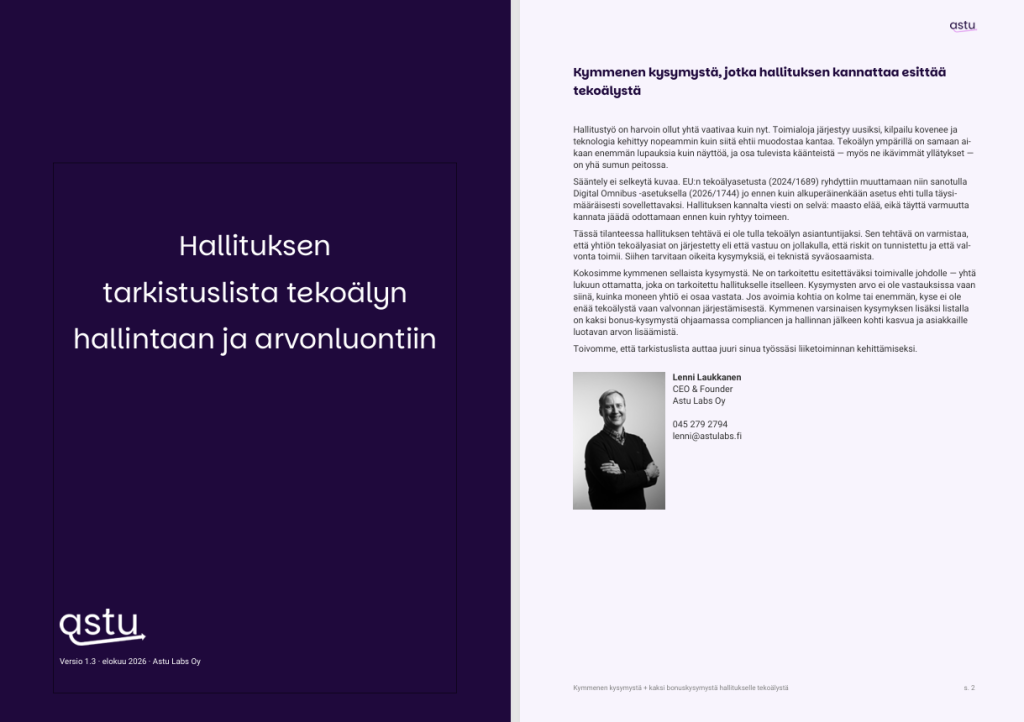
A board checklist for AI governance and value creation
Download the board checklist for governing AI and turning it into value. It contains ten questions plus two supplementary ones, together with a self-assessment form. The download starts directly from the button below — no contact details required.
The board AI review
Before anything can be overseen or steered, you need to know where you stand. The review is the quickest way to find out: together with the board, we work through twelve questions about the company's use of AI, its responsibilities and its risks, and assess jointly where the answers are already adequate — and what still needs to be decided, or handed to executive management as a task. A workshop, from €3,900 + VAT.

A workshop in which the board works through twelve concrete questions — one of which concerns the board itself. For each one, the board assesses whether the answer is known to a sufficient degree, known in part, or not known at all. Three or more open items is a sign that oversight needs to be set up properly, as a whole.

Where useful, the workshop can be preceded or followed by an interview with executive management, to sharpen the answers or to walk through responsibilities and compliance matters.

Around two hours of the board’s time, plus executive management’s readiness to answer questions, either in writing beforehand or on the spot. No advance materials are needed — a board-level picture emerges from the discussion, not from wading through documents.

We prefer to facilitate the workshop in person, although experience shows a successful workshop can also be run remotely. The workshop produces a written status table showing, in black and white, where the organisation’s capabilities are sufficient and where they are not — together with a proposal of three questions for the next meeting’s agenda, or three actions for executive management to carry out. Duration around two hours, priced from €3,900 + VAT.

The accountability model
When the review reveals gaps in responsibilities, policy or regulatory compliance, the next step is to close them. We build the board a named accountability model, an approved policy, a reporting framework and a risk map — the very things against which management's answers can, from then on, actually be judged. A fixed-price engagement, from €14,900 + VAT.

We build the structures without which a board cannot oversee the use of AI: a named owner with proper authority, a board-approved policy on what AI may be used for, standardised reporting with metrics, and a mapping of data and contract risks — including what happens if a service you rely on disappears or becomes substantially more expensive.

A named contact person from the company’s management, access to — or a joint walkthrough of — existing contracts and practices, and the board’s readiness to consider and approve the outcome at its meeting. We build nothing that the company does not ultimately own and run itself.

We proceed in stages: a review of the current state, drafting the structures together with management, and finalising them for the board’s consideration. Duration typically 6–8 calendar weeks, fixed price from €14,900 + VAT.

The board's AI annual cycle
Structures do not keep themselves up to date. The annual cycle is an ongoing service that keeps the board's AI understanding, competitor comparison and value tracking current — four times a year, without anyone having to remember to commission the work, or scramble whenever the situation demands it. From €2,400 per quarter (+ VAT).

A quarterly board brief that keeps three things current: a documented record of the board’s own AI competence maintained over time, a comparison of where your competitors are heading, and tracking of whether the AI investment is turning into growth, margin or a defensible competitive advantage — or remaining a set of isolated pilots.

One meeting’s or brief’s worth of the board’s time four times a year, a named contact person in management and an hour of their time each quarter, and access to the figures in which value shows up — for example throughput times, margin or customer retention. We do not need access to your systems; it is enough that the contact person supplies the numbers.

Ahead of each brief we speak with the contact person, review the materials provided, and produce and deliver a short written brief in good time before the board meeting — presenting it in person where needed. The agreement is ongoing and can be terminated at any time, billed quarterly from €2,400 per quarter (+ VAT).

FAQ – Frequently asked questions

AI has not arrived in organisations as projects, budgeted investments or go-live dates. It has arrived as free ChatGPT on an employee’s phone and as Copilot included in M365, and it is already involved in recruitment, sales and customer service — often without anyone having decided so. If the board believes AI is not being used, that is a finding in itself: it means the question has not been asked, and no one is reporting on it. Nor does regulation wait for a better moment — the statutory responsibilities already apply, whatever your starting point.

Delivery is management’s business. The board’s business is to make sure that responsibility has been assigned, risks identified and follow-up arranged — exactly as with any other material risk or investment. We do not do management’s work for them, nor around them. We support boards in their decision-making whenever that is needed for them to identify and discharge their own duties.

Usually yes, though for a different reason than you might expect. An operational governance model answers the question of how AI is used in the organisation. Board-level work answers the question of how the board oversees it — who is accountable, what is reported, with which metrics and how often. One does not replace the other. In practice, what we see more often is an existing policy drafted with care — but a board that has never received a reporting framework from it, or sufficient information to support its decision-making, ensure good governance and keep the company’s affairs properly organised.

One of our three senior partners — not a junior consultant. All of our partners have first-hand executive-team experience in Finnish SMEs, which means we have also sat on the other side of the table, answering a board’s questions. Governing AI is a leadership question before it is a technical one, and it calls for experience of leading a business, not merely of technology.

No. We are a technology-neutral partner, with no reseller agreements or commissions steering our recommendations. If the best answer to one of your questions is to buy nothing at all, we will say so.

The workshop: around two hours, once. The accountability model mainly requires the board to consider the outcome at its meeting; most of the work happens between executive management and us. The quarterly brief fits within a normal meeting agenda. We do not build the board a new meeting structure, and we do not pull focus from the board’s core duties — supporting those is our objective too.

No. The workshop is a stand-alone engagement, and its output is the board’s property regardless of whether the work continues. For some boards it reveals one or two gaps that management can close on its own — in which case the right recommendation is that you do not need us.

Our entire licence to operate rests on trust. We sign a non-disclosure agreement before any engagement begins. The workshop deals with the company’s internal affairs, and none of it travels into other engagements as examples. We are also committed to the code of ethics of the Finnish Management Consultants’ Association (Liikkeenjohdon konsultit ry), under which we undertake to take account of any conflicts of interest and to take all reasonable steps to protect the client’s interests and confidentiality. We further undertake to be aware of the client’s own code of conduct, and to take appropriate action — including informing the client — if complying with it proves problematic.

We work with small and mid-sized organisations, and the services are sized for boards that have no separate risk committee or dedicated AI officer. If the company already has a named AI lead and working reporting to the board, the sensible starting point is the quarterly brief rather than the workshop. The brief also covers market and competitor monitoring, where our vantage point across the market allows us to add considerable value.

Our clients
Would you like to join the front runners in putting AI to work?

Tell us your goals and the returns you are after — we will help you achieve them