The AI Leadership Plan is an Astu Labs service that gives your organisation a concrete plan for putting AI to use. The plan sets out what needs to be done, in what order, and who is responsible for what. Drawing it up typically takes 4–6 calendar weeks.
The service is intended for the leaders and leadership teams of small and mid-sized organisations that already have a picture of where they stand with AI, but no prioritised order for moving forward. The AI Leadership Plan covers five areas: people, leadership, governance, technology and data, and continuity.
Gap analysis – where does your organisation stand with AI today?
The gap analysis compares where your organisation is now against international best practice in AI, regulatory requirements, and Astu Labs' field observations from Finnish organisations. The analysis is done through interviews and by going through your documentation.
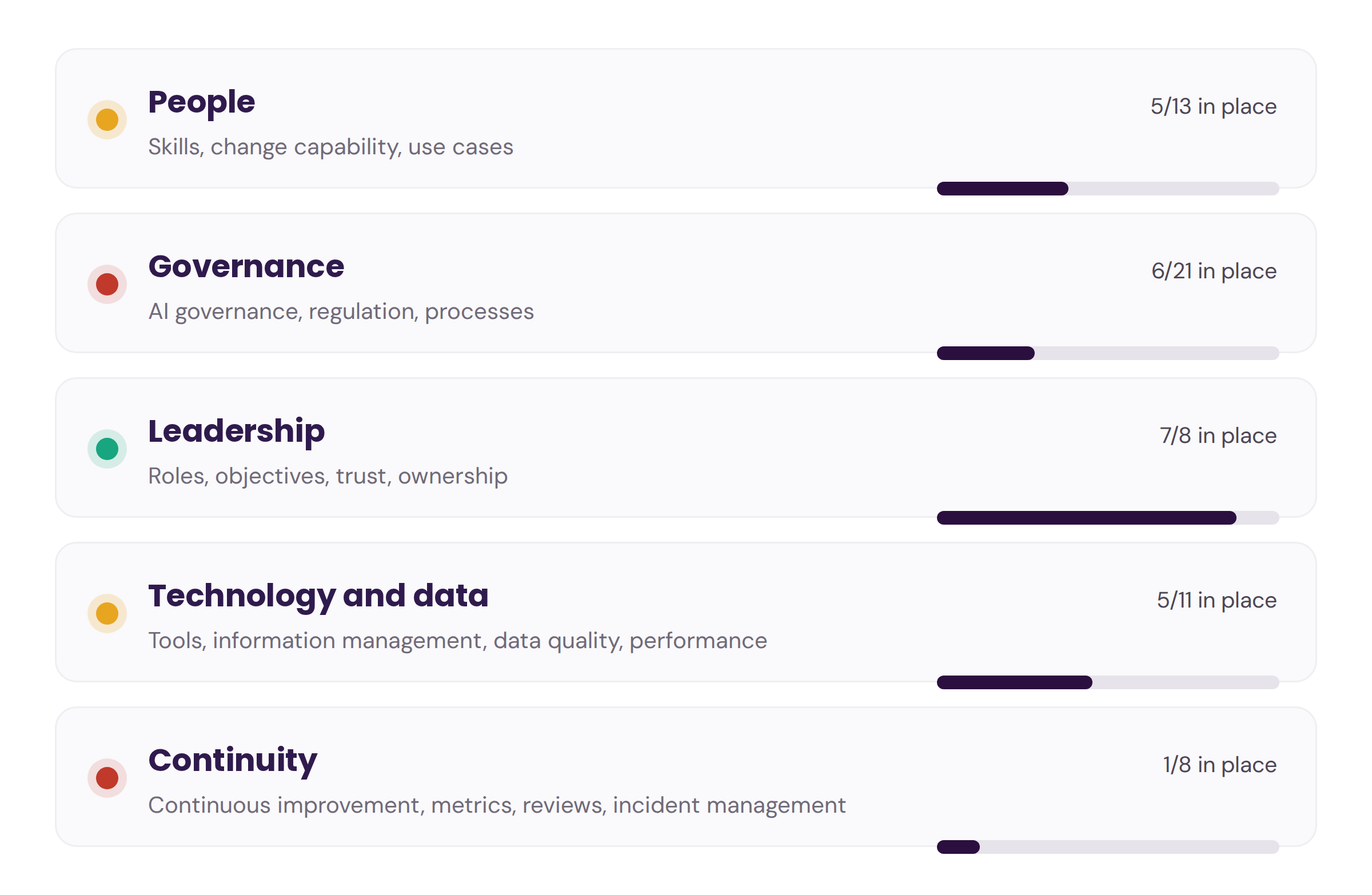
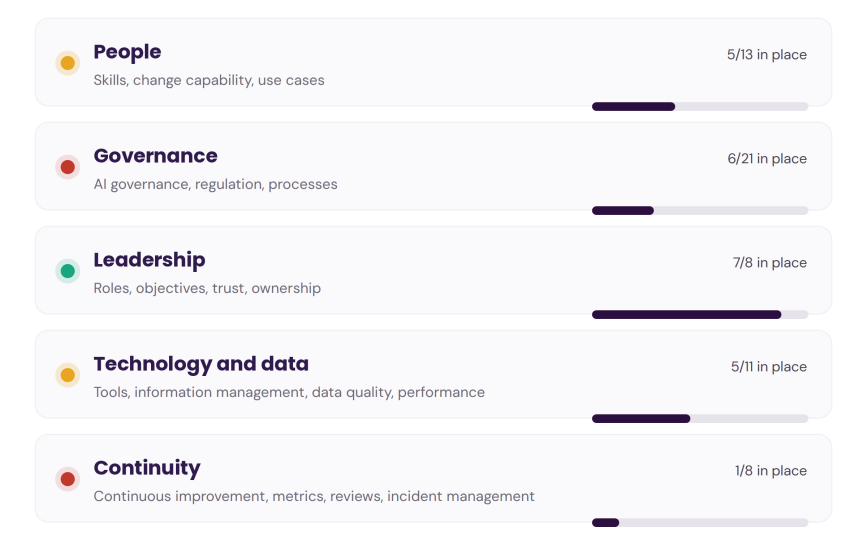
The analysis covers five areas and a total of 61 checkpoints:
- People (13 checkpoints): skills, capacity for change, use cases
- Leadership (8 checkpoints): roles, goals, trust, ownership
- Governance (21 checkpoints): AI governance, regulation, processes
- Technology and data (11 checkpoints): tools, information management, data quality, performance
- Continuity (8 checkpoints): continuous improvement, metrics, reviews, incident handling
Each checkpoint is rated as in order / lacking / missing. Where needed, the staff survey from Astu's Tilannekuva service is used, for example to gauge capacity for change.
Findings – what is the assessment based on?
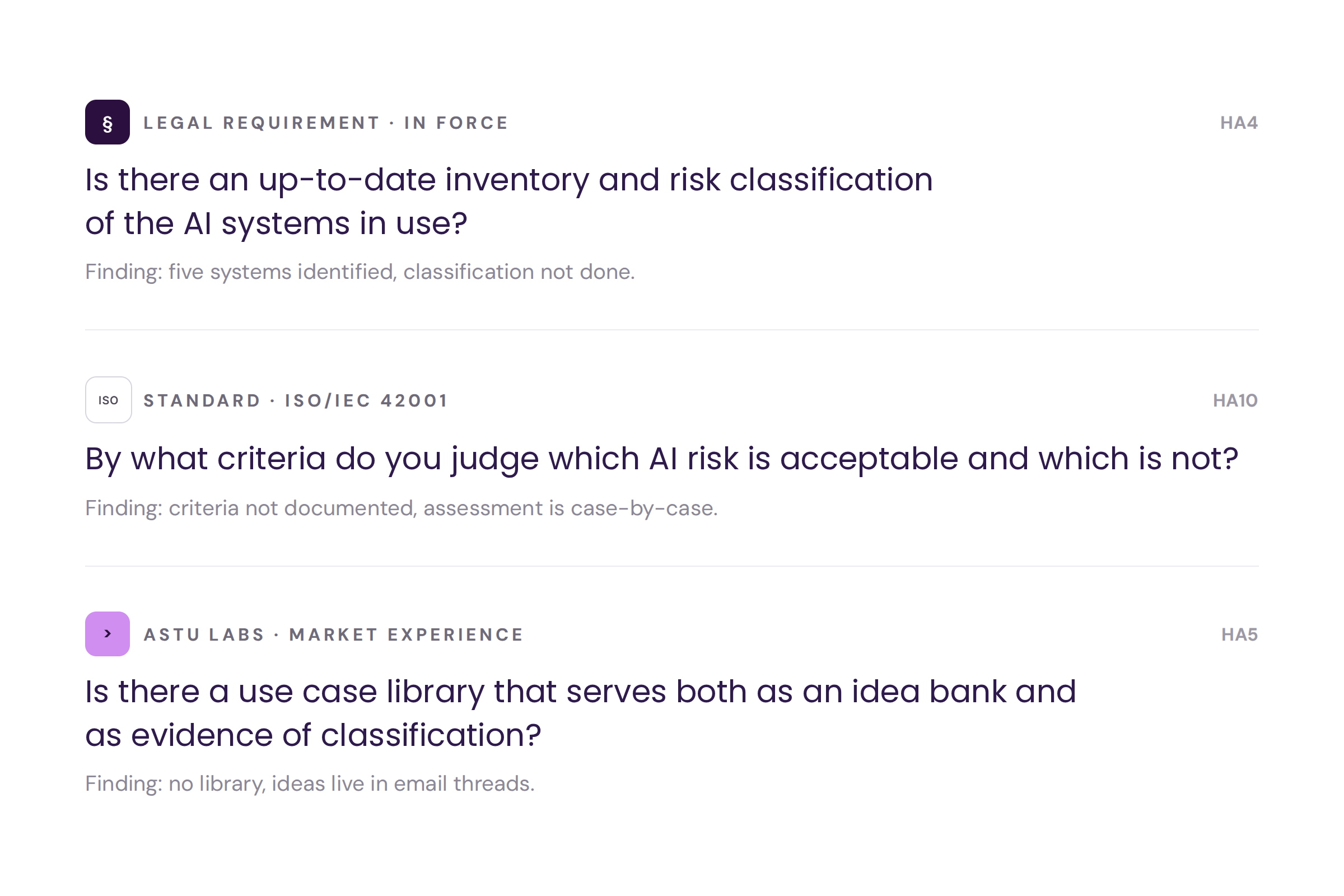
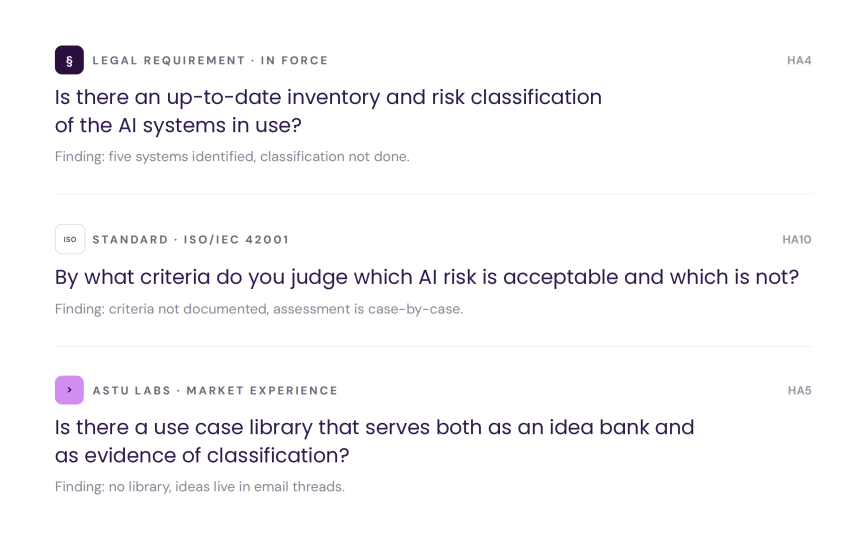
The gap analysis produces 61 documented findings, each traceable to its source. There are three sources: the EU AI Act, the ISO/IEC 42001 standard, and Astu Labs' field observations from Finnish organisations.
Each finding states what was assessed, what the current state is, and which requirement the point is based on.
Actions and reasoning – what gets done, who is responsible, and when
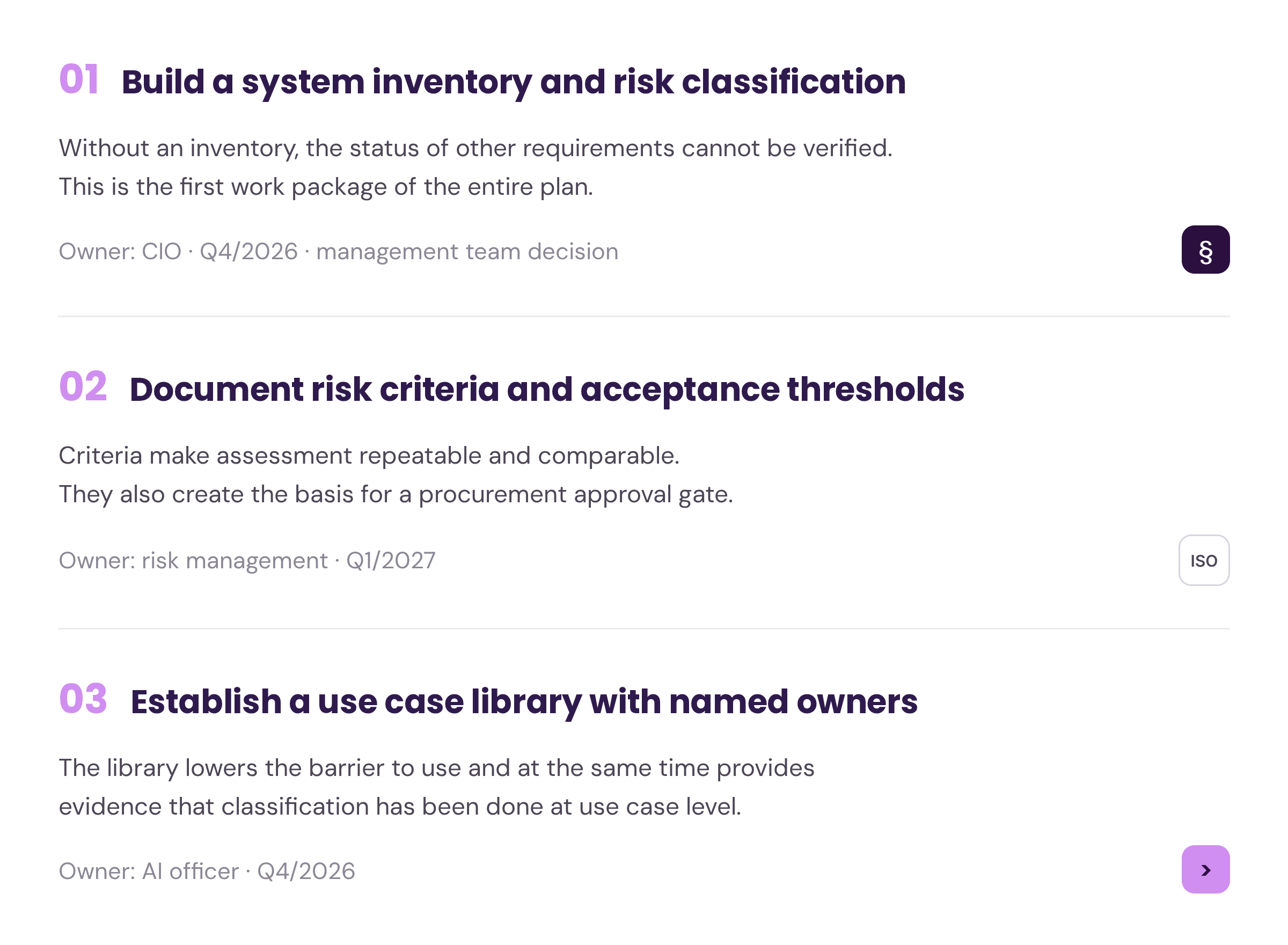
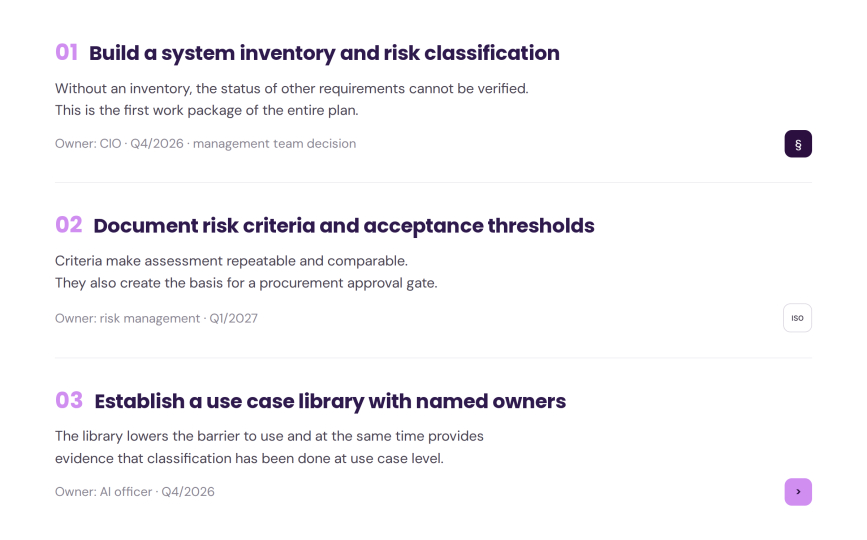
The findings are turned into a prioritised list of actions. Every action comes with its reasoning, the role responsible for it, timing to the nearest quarter, and the level at which the decision needs to be made.
Approving and scheduling the plan
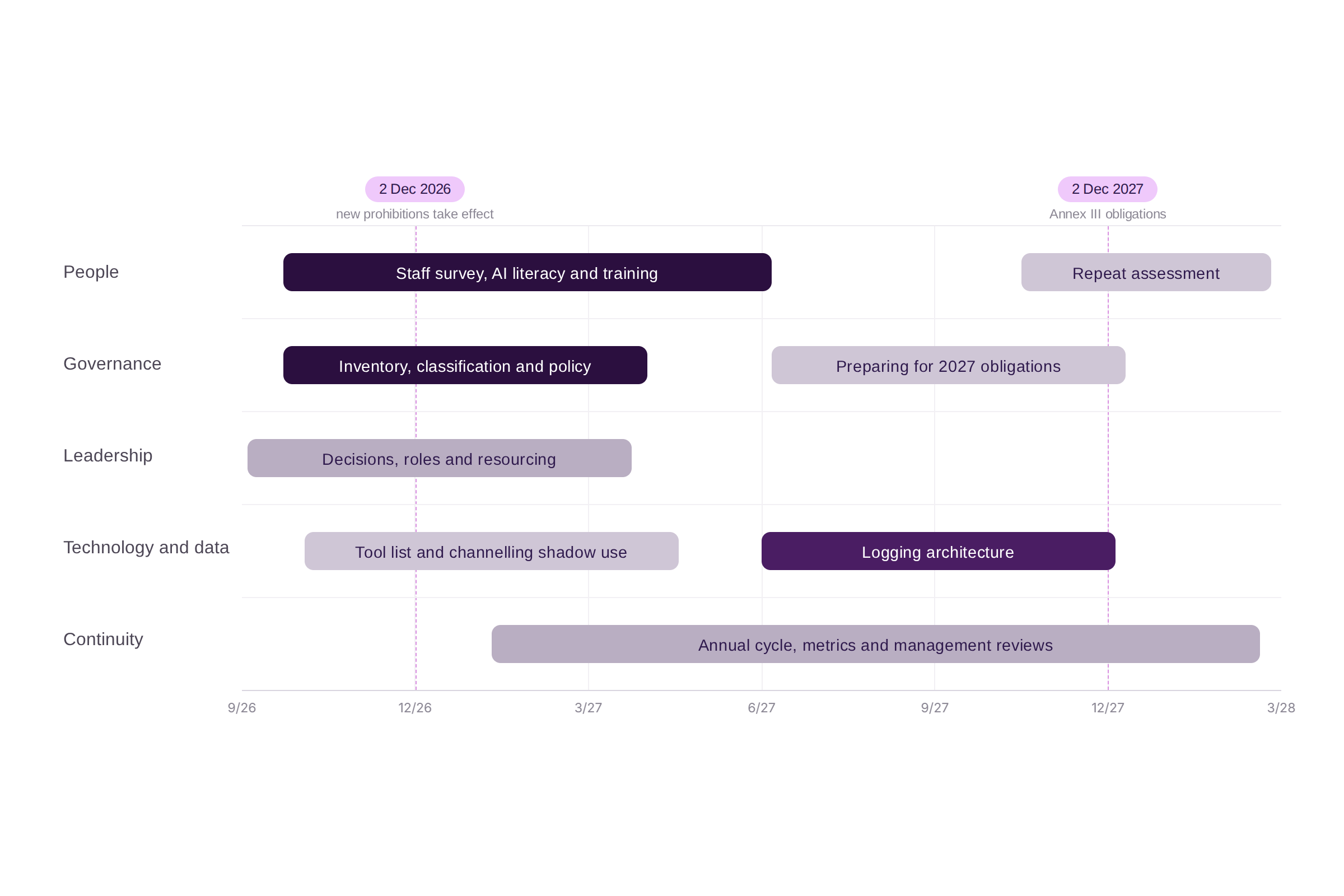
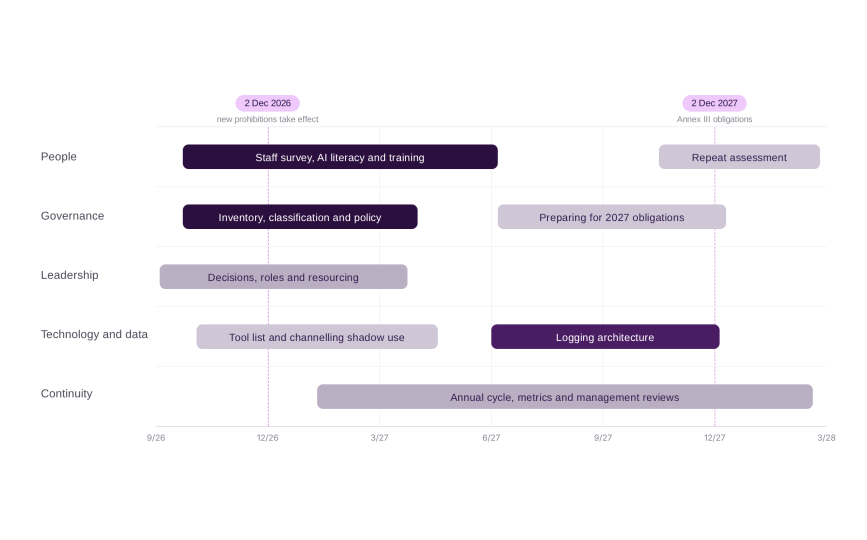
The actions are scheduled across an 18-month timeline. The leadership team approves the plan and decides on resourcing.
The schedule shows the work packages for each area side by side, so that dependencies and bottlenecks are visible.
The written plan
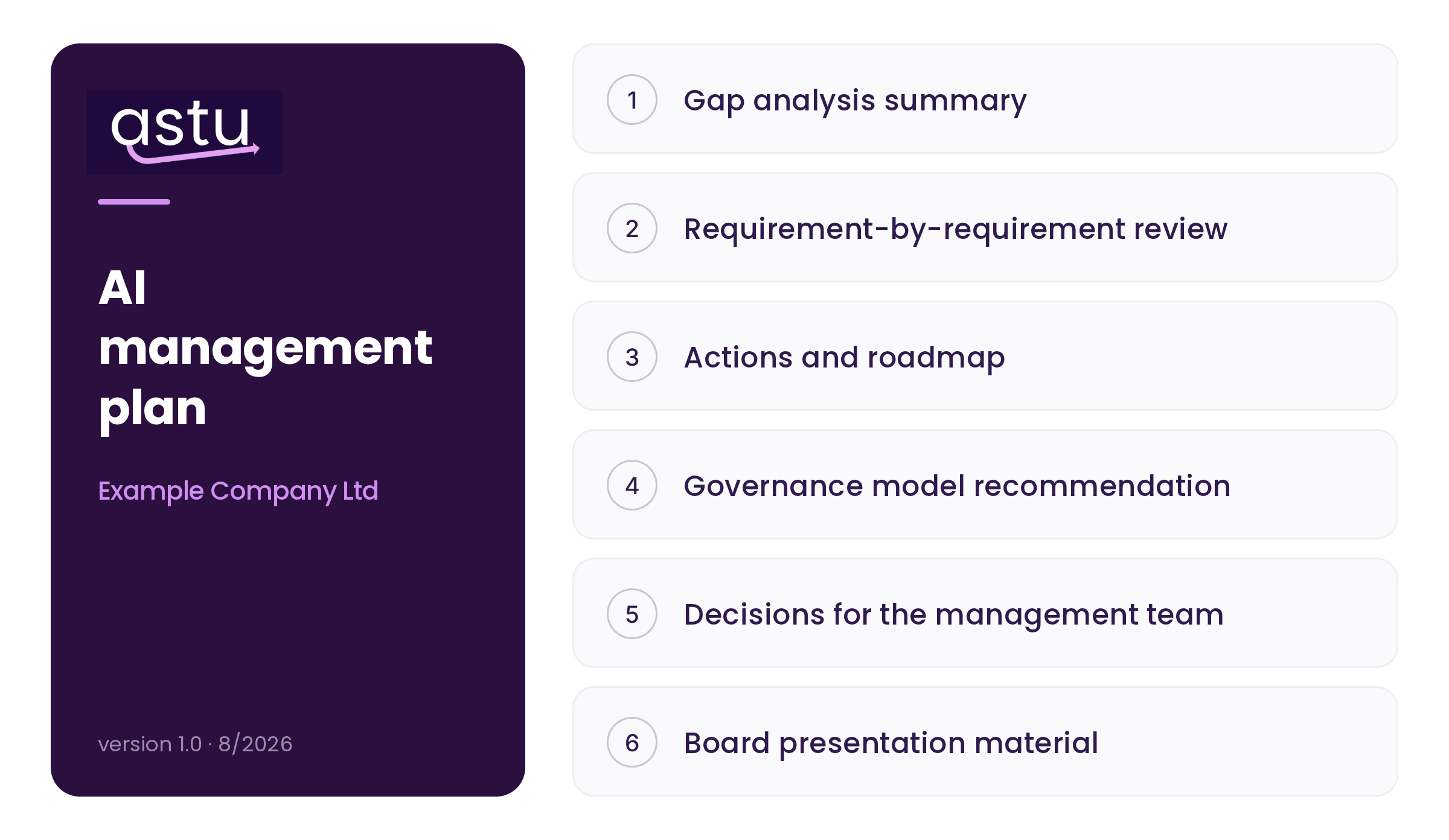
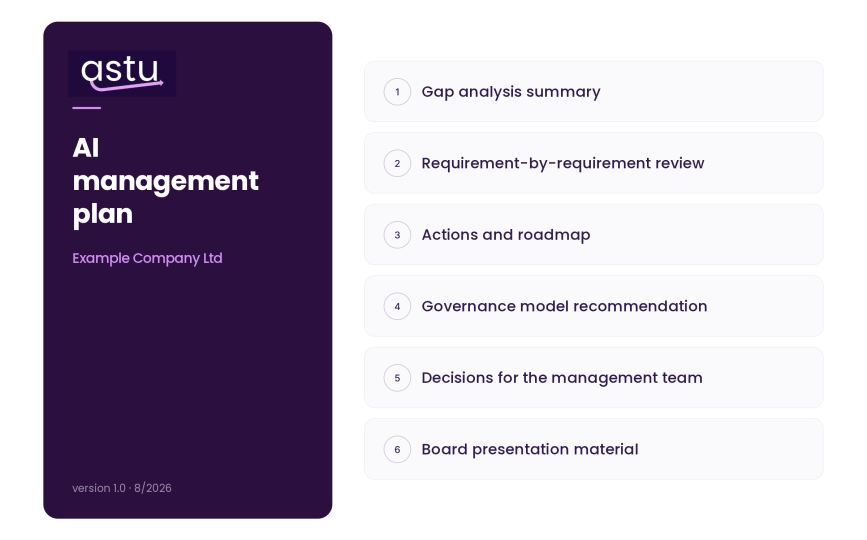
The plan serves the leadership, the board and the people doing the work, and it has six parts:
- Summary of the gap analysis
- A requirement-by-requirement walkthrough
- Actions and roadmap
- A recommended governance model
- Decisions needed from the leadership team
- Presentation material for the board
In our experience, the era of inspirational talks and AI maturity assessments is over — what’s needed now is concrete work that puts the conditions for measurable benefits in place.
The service is intended for the leaders and leadership teams of Finnish small, mid-sized and large organisations, typically of 50–750 people. It suits a situation where AI is already in use in several places, but no one owns the whole and the benefits cannot yet be shown in numbers.
The obligations for Annex III high-risk use cases moved to December 2027, and those for systems embedded in Annex I products to August 2028. The transparency obligations and the prohibitions, however, are already in force. Regulation is not the reason to make a plan. The reason is that money is going into AI without anyone owning the benefit.
The service was born in client work. Astu Labs has sat on the internal AI groups of several Finnish organisations, and the same pattern kept repeating: a group was set up, the first meetings went on working out the current state, everything that ought to be done and where to start — and only months later was it possible to begin the actual work, let alone settle into an ongoing routine.
The conclusion runs against intuition: the faster you want to get to the doing, the more it pays to put into the initial plan. Without one, the group spends its first months in discussion and starts over several times.